General Information
Eligibility and Admissions
Doctoral Tuition and Fees & Financial Aid
Academic Calendar and Required Credits
Examination and Evaluation
Frequently Asked Questions
General Information
Eligibility and Admissions
Doctoral Tuition and Fees & Financial Aid
Academic Calendar and Required Credits
Academic Calendar and Required Credits
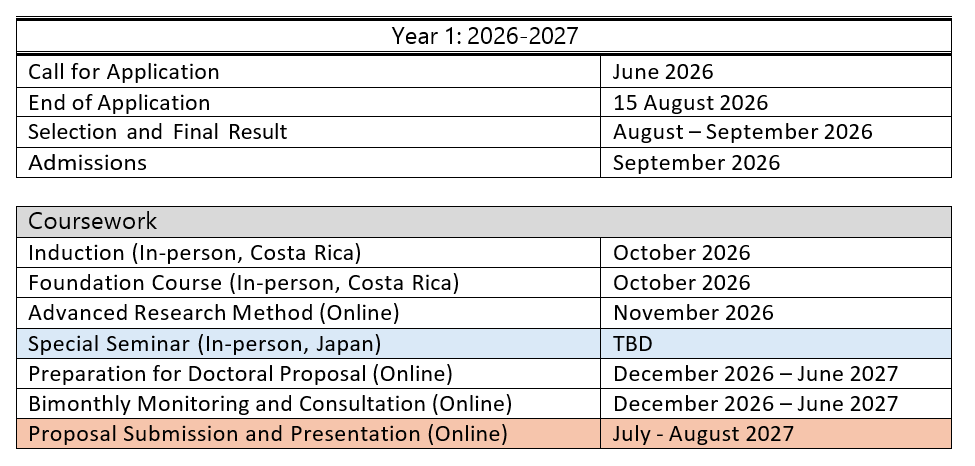
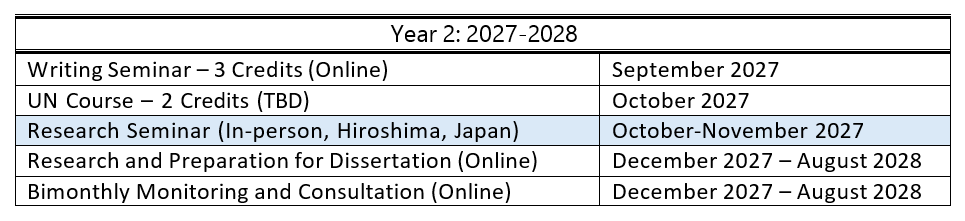
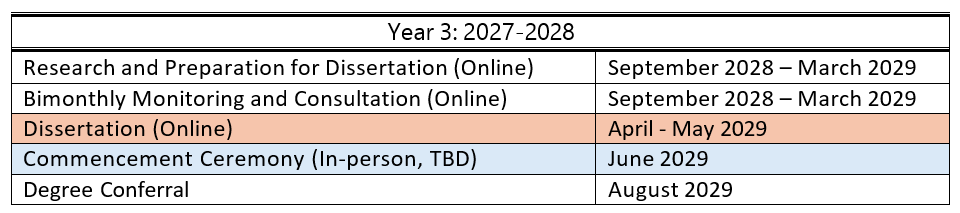
All doctoral students must complete 120 academic credits to obtain the UPEACE doctoral degree. Credits will be awarded as follows:
1. Research
i. Doctoral Proposal: 40 academic credits
ii. Doctoral Dissertation: 60 academic credits
2. Courses
i. Foundation Course on Peace and Conflict Studies: 3 academic credits
ii. United Nations Course: 2 academic credits
iii. Advanced Research Methods: 3 academic credits
iv. Writing Seminar: 3 academic credits
v. Special Seminar: 3 academic credits
The timing of the above-listed activities is subject to change depending on programme needs and circumstances.
The remaining 6 academic credits must be completed through other courses offered at UPEACE Headquarters or at a partner university between Year 1 and Year 2. At least one course must be completed in person at UPEACE Headquarters in Costa Rica. The number of credits assigned to the Research Seminar at HCU is to be confirmed.
Each year, all doctoral students are expected to actively participate in webinars and other academic activities designed to strengthen their knowledge of topics researched at UPEACE. The Doctoral Programme Coordinator will inform students about these activities and make the relevant materials available in the virtual classroom.
Supervisors may assign additional requirements for their doctoral students, which may be completed either in person or online. Supervisors may also recommend that a doctoral student enroll in courses offered by institutions other than UPEACE if they consider this necessary for the student’s academic progress.
Students may spend extended periods at UPEACE Headquarters outside the scheduled coursework if they wish. In such cases, UPEACE will provide visa support.
Examination and Evaluation
Examination and Evaluation
Phase I – Proposal Presentation
The first stage of the doctoral process should be understood not primarily as a formal examination, but rather as an important academic milestone centered on dialogue, reflection, and collaborative development. Consistent with the educational philosophy of the Programme and its emphasis on community-building, practice-oriented learning, and intellectual exchange, doctoral candidates will present their emerging research projects before faculty members, peers, supervisors, and members of the broader academic community.
The purpose of this stage is to create an environment of co-creation and scholarly engagement, where ideas can be refined through constructive feedback, interdisciplinary discussion, and collective reflection. Rather than serving exclusively as a gatekeeping exercise, this process is intended to support doctoral students in strengthening the conceptual foundations, methodological design, and practical relevance of their research. In keeping with the Programme’s belief that knowledge is built through dialogue and shared inquiry, the proposal presentation constitutes an opportunity for candidates to benefit from the experiences and perspectives of a diverse academic and professional community before moving into the next phase of their doctoral journey.
The proposal should follow the same outline as any research proposal, and it should be between 10,000 and 15,000 words, approximately 20 to 30 pages. The literature review, theory, and methodology sections of the proposal should be complete chapters as they might exist within the final dissertation. The proposal should include the following, without limitation:
• Statement of Purpose
• Background, Significance, and Contribution
• Critical Literature Review
• Theoretical Framework
• Methodology
• Ethical Considerations
Format details will be provided through programme guidelines after admission.
Evaluation Criteria
Approval of the doctoral proposal is based on the following criteria:
- Significance and Relevance of the Topic
The topic must be sufficiently original, important, and aligned with the student’s research interests. It should contribute meaningfully to the literature, be of interest to experts in the field, and support the student’s short- and long-term academic and career development. - Soundness of Research Design
The proposal must demonstrate a feasible and well-structured research design, with no critical flaws in methodology, data availability, or analysis at the time of the proposal defense. - Theoretical and Methodological Alignment
The proposed theoretical framework must be consistent with the methodology and grounded in relevant existing literature. - Student Preparedness
The student must be adequately prepared both academically and, where applicable, financially to complete the research. - Contribution to Knowledge
The proposal must clearly identify a gap in the literature and demonstrate how the research will make a significant and original contribution to the field through theoretical, conceptual, or methodological advancement.
Note: Approval of the proposal does not guarantee successful completion of the dissertation; however, a well-developed proposal reduces the risk of future challenges.
Phase II – Dissertation Defense
The Doctoral Dissertation should demonstrate the achievement of the goals indicated in the Doctoral Proposal. In the dissertation, the doctoral candidate will demonstrate critical thinking and the ability to formulate a clear argument. The dissertation must be systematically organized, and the analysis presented must be substantiated with the key literature in the student’s field. The student’s data and analysis will make a substantive and unique contribution to the field.
Doctoral Students need to keep in mind that long dissertations are not equal to better dissertations. Thus, the type and length of the doctoral dissertation will vary in accordance with the work developed by each student. In any case, and whichever stylistic format is adopted, the dissertation should be between 40,000 and 50,000 words, approximately 80 to 120 pages, and cover the following elements:
• Statement of Purpose
• Background, Significance, and Contribution
• Critical Literature Review
• Theoretical Framework
• Methodology
• Ethical Considerations
• Results and Discussion
• Conclusion
• Literature Citation, excluded from word count
Format details will be provided through programme guidelines after admission.
Evaluation Criteria
To fulfill the degree requirements, the dissertation must make a significant and original contribution to knowledge and demonstrate the candidate’s capacity to conduct independent, high-quality research.
Members of the Dissertation Committee shall provide written evaluations confirming whether:
• The dissertation makes a significant contribution to knowledge and advances understanding of the subject;
• The candidate demonstrates the ability to conduct independent, high-quality research;
• The dissertation contains material of publishable standard;
• Adequate knowledge of the state of the art in the field is demonstrated;
• The overall format and presentation meet acceptable academic standards.
The Dissertation Committee shall decide on acceptance of the dissertation by majority vote and recommend whether the doctoral degree should be awarded. In cases of significant disagreement among examiners, additional examiners shall be appointed by the Doctoral Committee.
Examiners shall assess the dissertation prior to authorizing progression to the oral examination. Where substantial revisions are required, the candidate may be instructed to revise and resubmit the dissertation within a specified period. Failure to comply will result in rejection of the dissertation. If revisions are satisfactorily completed, the candidate may proceed to the oral examination.
At the oral examination, the Dissertation Committee shall reach one of the following decisions:
- Approved: No revisions required; the candidate meets all academic standards and may be awarded the doctoral degree. An Honorific Mention may be granted at the Committee’s discretion.
- Approved with Minor Revisions: The candidate must complete specified revisions, which shall be communicated orally and in writing.
- Rejected
Where minor revisions are required, the candidate shall have up to six (6) months to submit the revised dissertation. Examiners shall confirm whether revisions have been satisfactorily completed. Only one resubmission opportunity is permitted; failure to meet the requirements will result in rejection, and the doctoral degree will not be awarded.
Frequently Asked Questions
Frequently Asked Questions
1. Can I propose a supervisor who is not a UPEACE Resident Faculty member?
Yes. You may propose an external supervisor by including their name in your Statement of Purpose. If available, please also provide their contact information.
2. Can I submit a recommendation letter from a UPEACE Resident Faculty member?
Yes, you may submit a recommendation letter from a UPEACE Resident Faculty member.
3. I do not have an English certificate, but I studied in English. Can I submit my diploma instead?
Yes. You may submit your diploma along with a letter certifying that your previous programme was conducted in English.
4. I do not have an English certificate, but my working language is English. What document can I submit?
You may submit a letter from your employer confirming that English is your primary working language.
5. What are the main programme milestones?
- Proposal Submission and Presentation (First Milestone): Includes both a written and oral assessment. Once passed, you are granted the status of Doctoral Candidate.
- Dissertation Evaluation (Second Milestone): After the candidacy stage, you will collect and analyze your data, write your dissertation, and submit it for evaluation. Approval of your dissertation marks the final milestone of the programme.
6. When should I go to Costa Rica to attend course(s) in Costa Rica?
You are encouraged to complete the residency within the first year of your programme. However, you may choose another time that suits you. Please avoid scheduling your residency between December and January, when the university is closed for the holidays.
7. Can I stay in Costa Rica for a longer period?
Yes. You are welcome to spend an extended period at UPEACE headquarters if you wish. UPEACE will assist you with a visa application.
Dr. Jan Breitling
Resident Professor

Dr. Mihir Kanade
Resident Professor
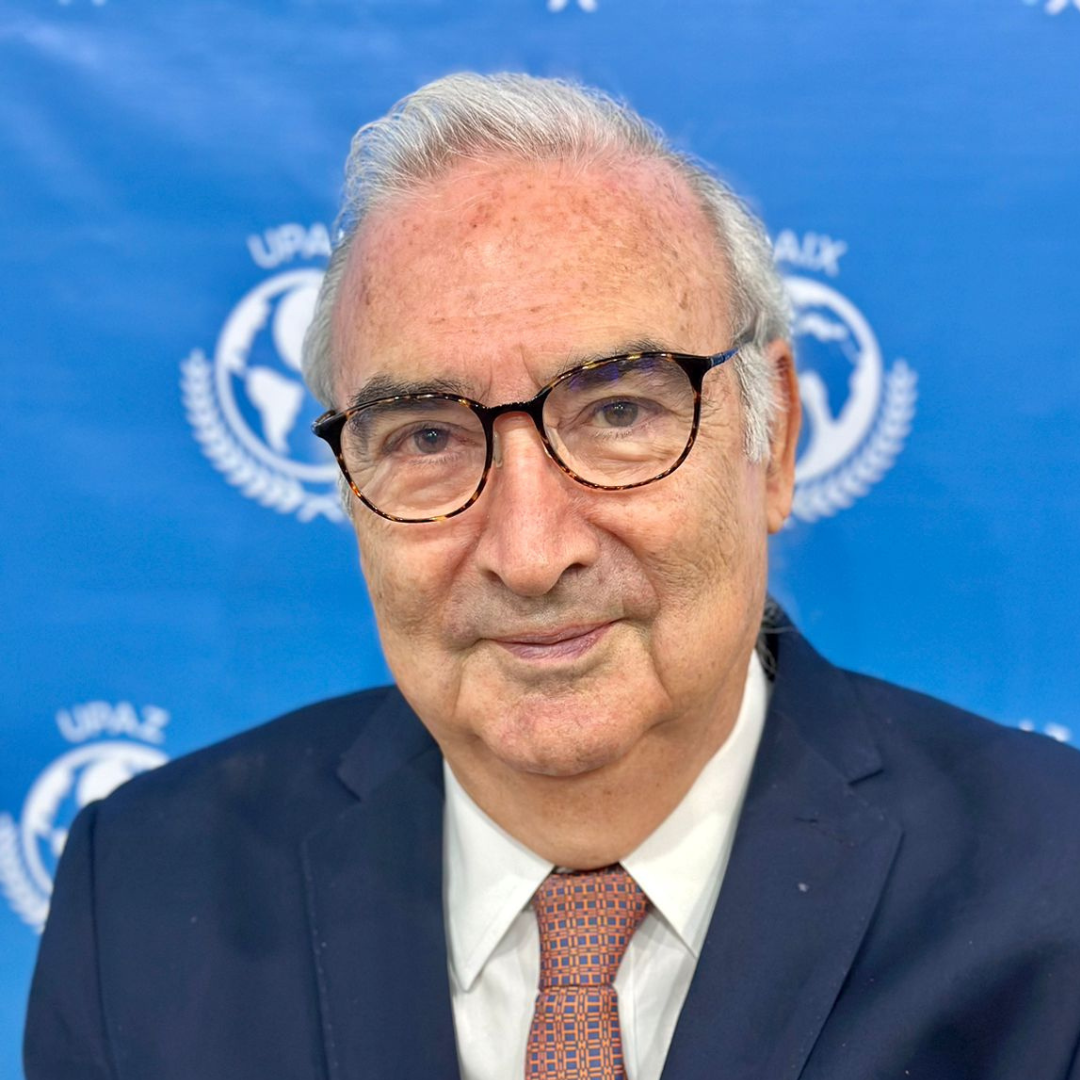
Dr. Francisco Rojas
Rector
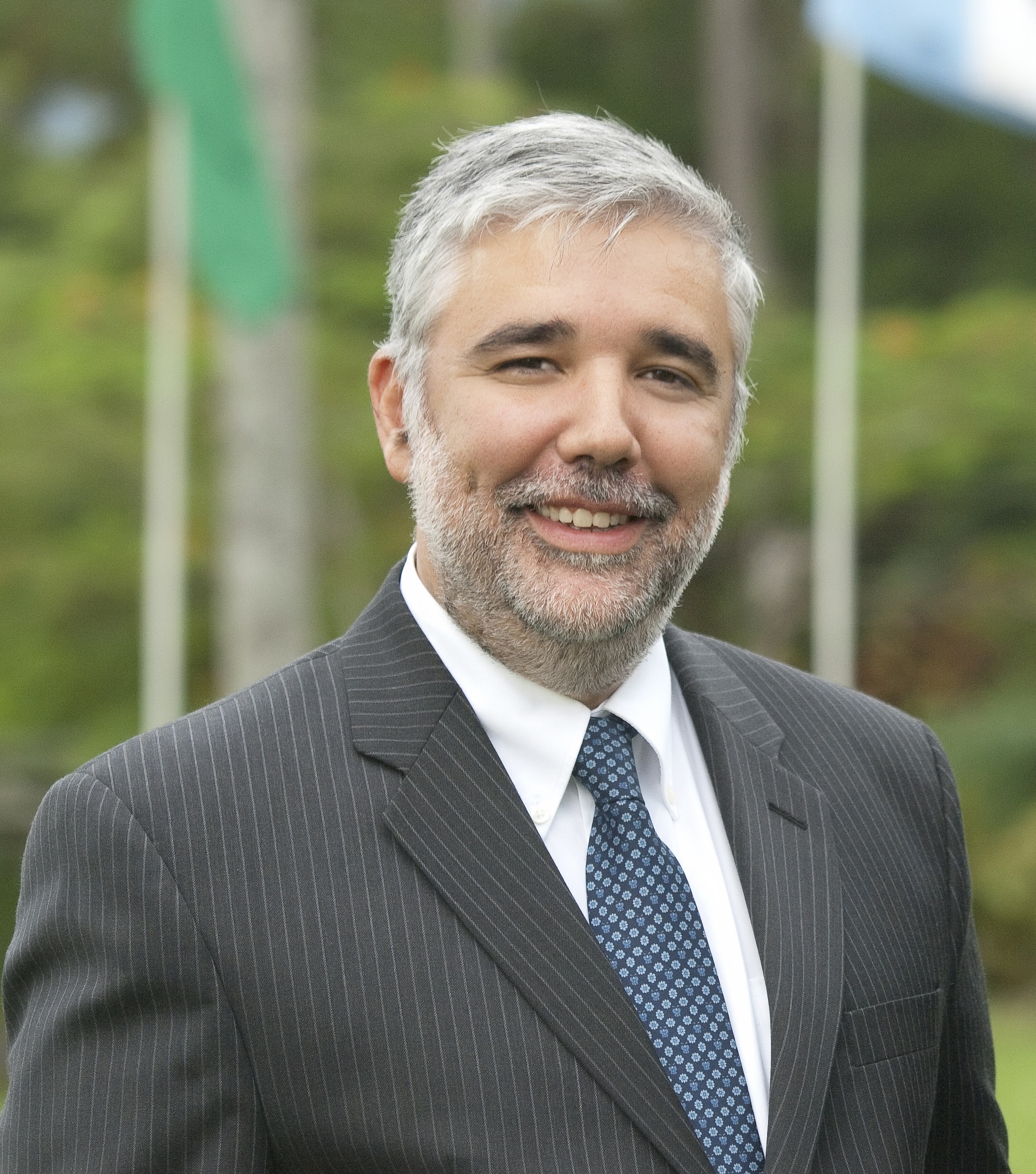
Dr. Juan Carlos Sainz
Vice Rector

Dr. Adriana Salcedo
Resident Professor

Dr. Olivia Sylvester
Resident Professor
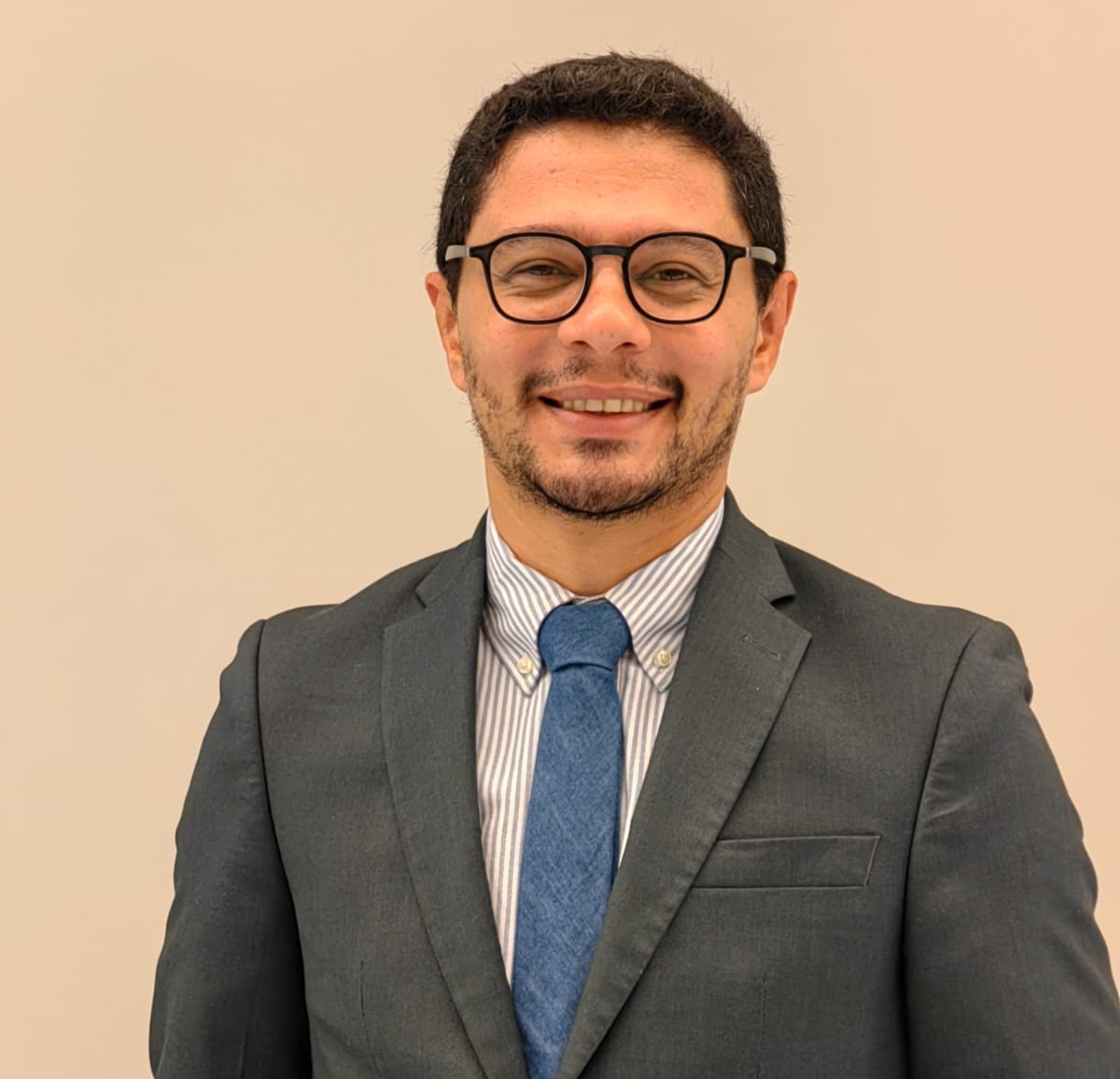
Dr. Mauricio Vieira
Resident Professor
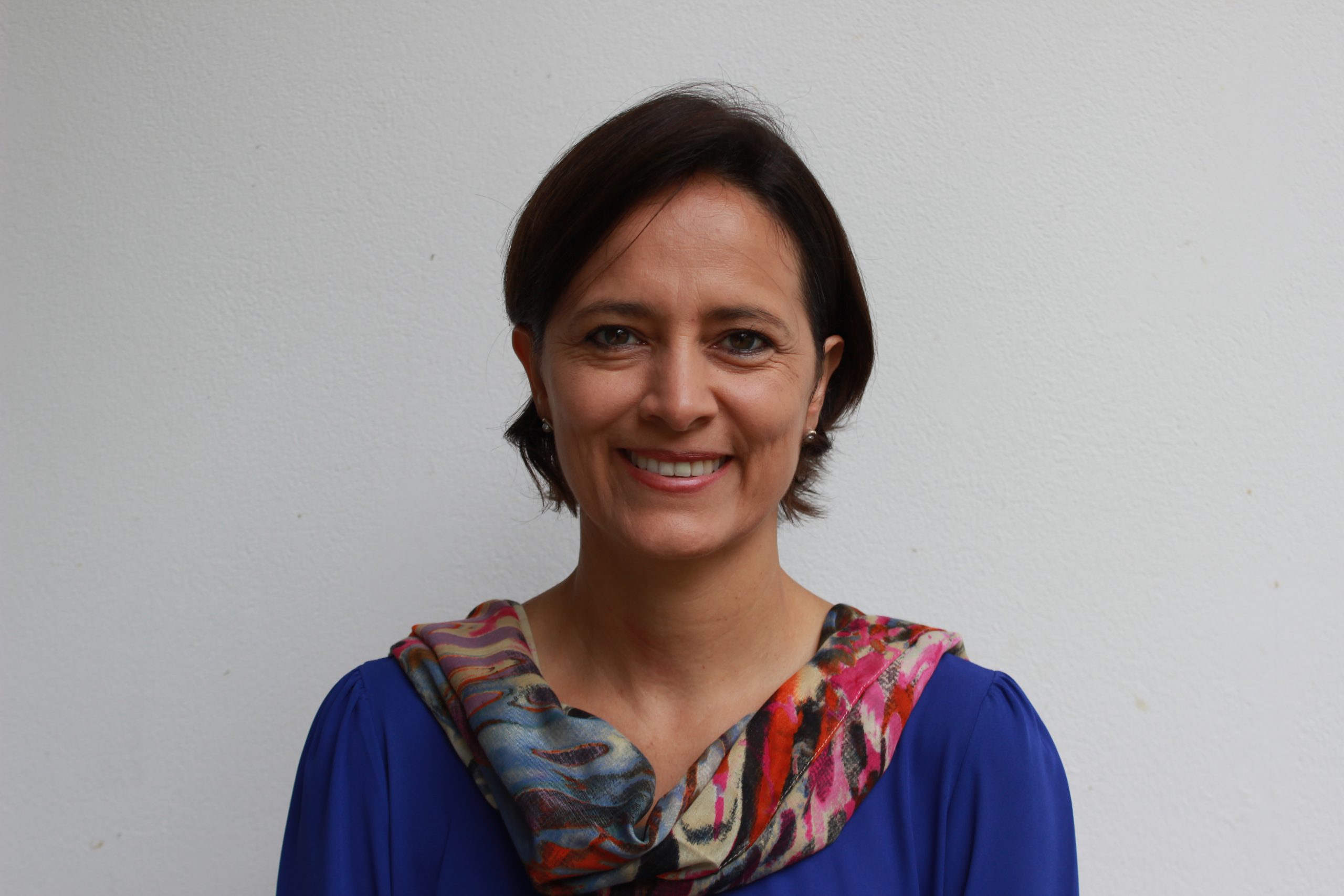
Dr. Mirian Vilela
Resident Professor